Why the financial conversation changes as your business grows.
By Alex Redmond, Founder of Affinity Richmond
Alex has spent more than 20 years advising owner-managed businesses, helping founders build stronger, more profitable companies through better financial decision-making.
Several years ago I read The E-Myth by Michael Gerber and it put into words what I’d been observing for years. Afterwards, whenever a new client came along, I found myself giving them a copy. I probably contributed more than a little to Gerber’s royalties.
The reason I gave and recommended the book so often is not because it was about finances or cashflow. It isn’t. It’s about what happens when someone who is very good at something decides to build a business around it.
Gerber’s premise is that most businesses begin with an “entrepreneurial seizure”. A talented technician – be it a designer, filmmaker, or architect – decides they can do a better job than their employer, so they decide to give it a go on their own. Often it works well at first, they win work because they’re good at what they do, clients come back and recommend them to others, and the business grows.
The sting comes when, almost without noticing, they discover they’re no longer spending their time doing the thing they loved, the thing they have talent and motivation for in spades.
Instead they’re running a business.
They spend less time designing, filming, creating and more time recruiting, pricing, managing cashflow, solving people problems and making decisions that affect the future of the business. I’ve been working with owner-managed businesses for more than twenty years and I’ve lost count of the amount of times I’ve seen this happen. Quite a feat for a numbers guy.
It doesn’t happen because founders lose their passion (although that can be a side-effect); growth simply changes the nature of the job. What do I mean exactly?
The questions begin to change
Well, the questions become different for a start. In the early years, financial conversations were mainly about compliance. Reliable bookkeeping, accurate accounts, tax returns completed on time – these foundations are indispensable, a good accountant doesn’t simply keep HMRC happy and make sure everything is compliant, they provide the accurate financial information on which every decision depends.
However, as the business grows, the questions change. They’re no longer asking, “When is the VAT submission due?” or “How much corporation tax will we owe?”
More complex questions come into view, like whether they can afford to recruit another team member, whether they should increase prices, which clients are contributing to profitability, whether they have cash to invest, or why turnover has grown, but the bank balance still feels uncomfortably tight?
These kinds of questions can’t be answered by looking at last year’s accounts. They require an in-depth understanding of where the business is today, where it’s trying to get to, and what the financial consequences of different decisions might be.
When “roughly” isn’t enough
I recently had a conversation that illustrates this point.
I asked an owner of a creative business whether they knew which of their clients generated the most profit. After thinking for a moment, their reply was “I know roughly”. It’s a human answer that many business owners would recognise. We all rely on “roughly” in everyday life. Roughly how much pasta to cook for four or roughly how long it takes to get to the office. But in business, “roughly” becomes more expensive.
Recruiting someone because you feel like the business can cope (fingers crossed) is very different from recruiting someone knowing you understand the impact on cashflow over the next few years. Taking on another large client sounds fantastic, but choosing the wrong client doesn’t just waste time; it consumes capacity that could have been used elsewhere. Growing turnover is positive – high five – but only if profitability is growing with it.
These kinds of situations can cause owners to think they’ve lost their magic, that their judgement has deteriorated. Rather, it’s simply that the business has become too complex to run on instinct alone.
“The businesses that come to us don’t usually come because they’ve outgrown their accountant. They come because they’ve outgrown uncertainty”
Alex Redmond
One of the things I’ve noticed over the years is that founders rarely ask for better financial information. The questions that keep them up at night and that they raise tentatively around our meeting table, are usually some variation of asking for confidence.
Confidence that they can afford to recruit. Confidence that the business is moving in the right direction. Confidence to say yes to an opportunity without jeopardising everything they’ve built so far.
And that’s a very different conversation.
Often they don’t really know what they need; they simply know that the decisions feel bigger and the advice needs to be more specific and more bespoke. Whether you call the role a Finance Director, a Chief Financial Officer (CFO) or a Fractional CFO, the title matters less than the purpose. Their role is to help owners use financial information to make better decisions. One of the biggest misconceptions is that a Finance Director replaces an accountant, but in reality they perform different roles. The two roles complement each other but they are trying to achieve different things.
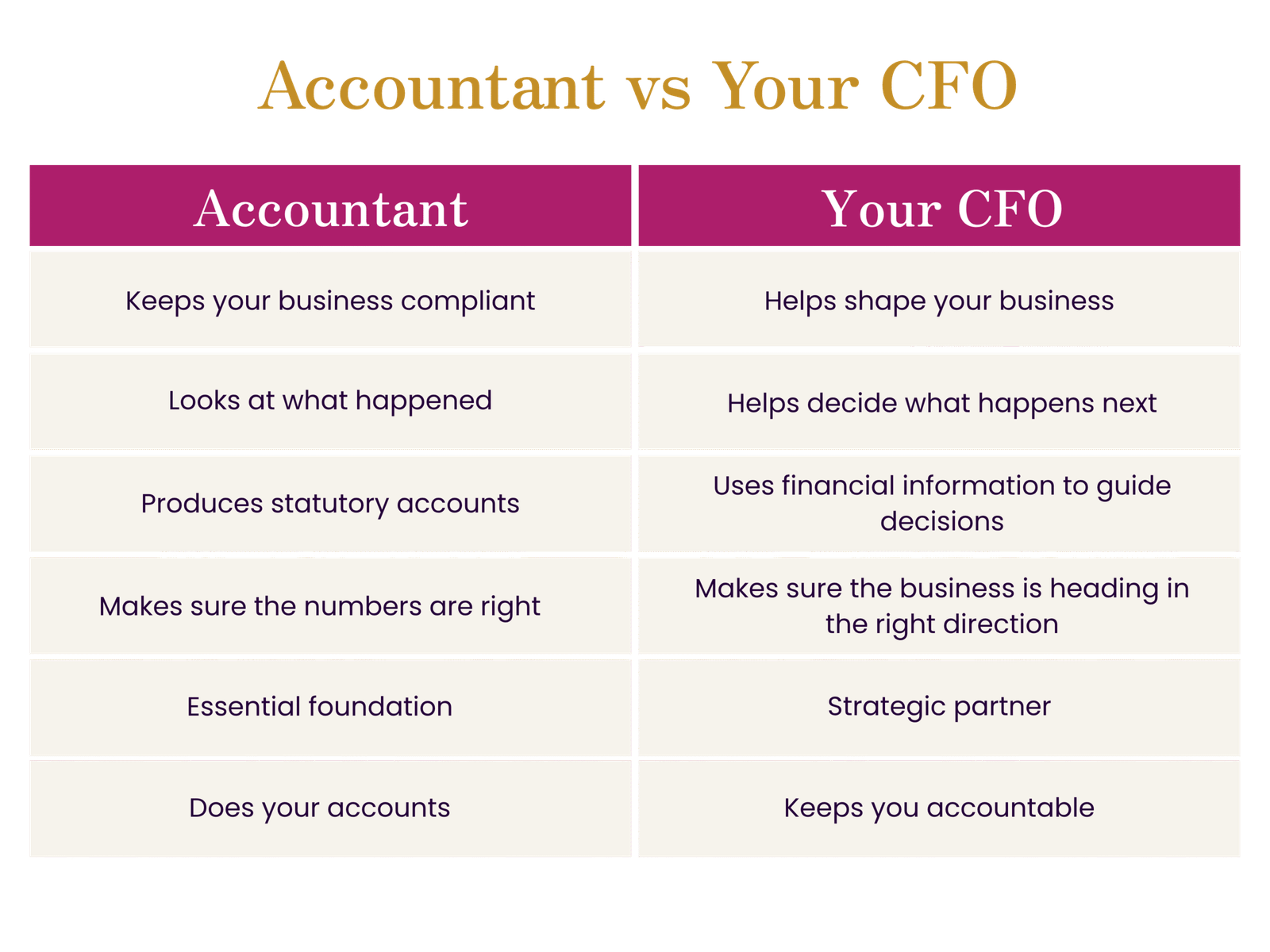
As we’ve already covered, your accountant’s responsibility is essentially to ensure that your financial records are up to date and your business is compliant with HMRC. This is just as important, and becomes more complex as your business grows.
The role of the CFO is to interpret the information, understand what it means, assist you to understand what it means, and use it to help shape the future of the business. They should challenge assumptions, test ideas, help you explore different scenarios and understand the consequences of important decisions before they are made.
In a nutshell, an accountant helps you understand the business you’ve built, while a finance officer helps you to build the business that you want. Both roles are important and they solve different problems.
In large organisations this strategic role is usually carried out by a full-time Chief Financial Officer or Finance Director. Most owner-managed businesses don’t need that level, but many reach a point where they would significantly benefit from the same quality of thinking. This was one of the reasons I started Affinity Richmond. Having worked at organisations like Lucas and McLaren, I’d seen first-hand the value of high-quality financial leadership. I wanted to make the same calibre of thinking available to ambitious owner-managed businesses.
So how does a Fractional CFO work?
Over the years, I’ve found these conversations follow a consistent pattern. Before we can talk properly about growth we first need to understand where the business really stands. Before we can measure progress, we have to agree what success actually looks like. Once these foundations are in, the conversation becomes one of maintaining visibility (by which I mean really seeing your business, the numbers, the strengths, the weakness, the opportunities and the threats), reviewing performance regularly and adjusting course as circumstances change.
Eventually this process became the basis for Your CFO and the Affinity Compass.
The Compass begins by establishing a clear understanding of where the business stands today. From there, it helps define where the owner wants to go, creates the visibility needed to make informed decisions and establishes a regular rhythm of reviewing progress and adjusting course.
Fundamentally, it is based on the same lesson at the heart of The E-Myth. As businesses mature, success depends less on instinct and more on building systems, structure and visibility that allow good decisions to be repeated consistently.
The businesses that come to us for this kind of support almost never begin the conversation by saying they need a CFO. They also don’t usually come to us because they’ve outgrown their accountant. They come because they’ve outgrown uncertainty.
They still need excellent bookkeeping, accurate accounts and sound tax advice. What they also need is strategic financial support. Someone who can help find the answers that aren’t found in the statutory accounts. Answers for questions about growth, investment, pricing, profitability and the future of the business. When the numbers stop being an historical record of what happened, and become one of the tools that shapes what happens next.
Thinking differently about your business?
If your business has reached the point where questions are becoming more strategic than operational, then let’s have a conversation.